
Porcelain Veneers in Antalya: What to Expect
An honest guide to porcelain veneers in Antalya: materials, candidacy, the enamel-removal trade-off, aftercare and what to verify before booking.
What you need to know
An honest guide to porcelain veneers in Antalya: materials, candidacy, the enamel-removal trade-off, aftercare and what to verify before booking.
An honest guide to porcelain veneers in Antalya: materials, candidacy, the enamel-removal trade-off, aftercare and what to verify before booking.
Porcelain veneers are thin, custom-made shells bonded to the front of your teeth to change their colour, shape or alignment. In Antalya, the process usually takes two dental visits a few days apart — one for preparation and digital impressions, one for fitting — and the biggest honest trade-off to understand before booking is that a small amount of enamel is removed and cannot grow back.
What Are Porcelain Veneers?
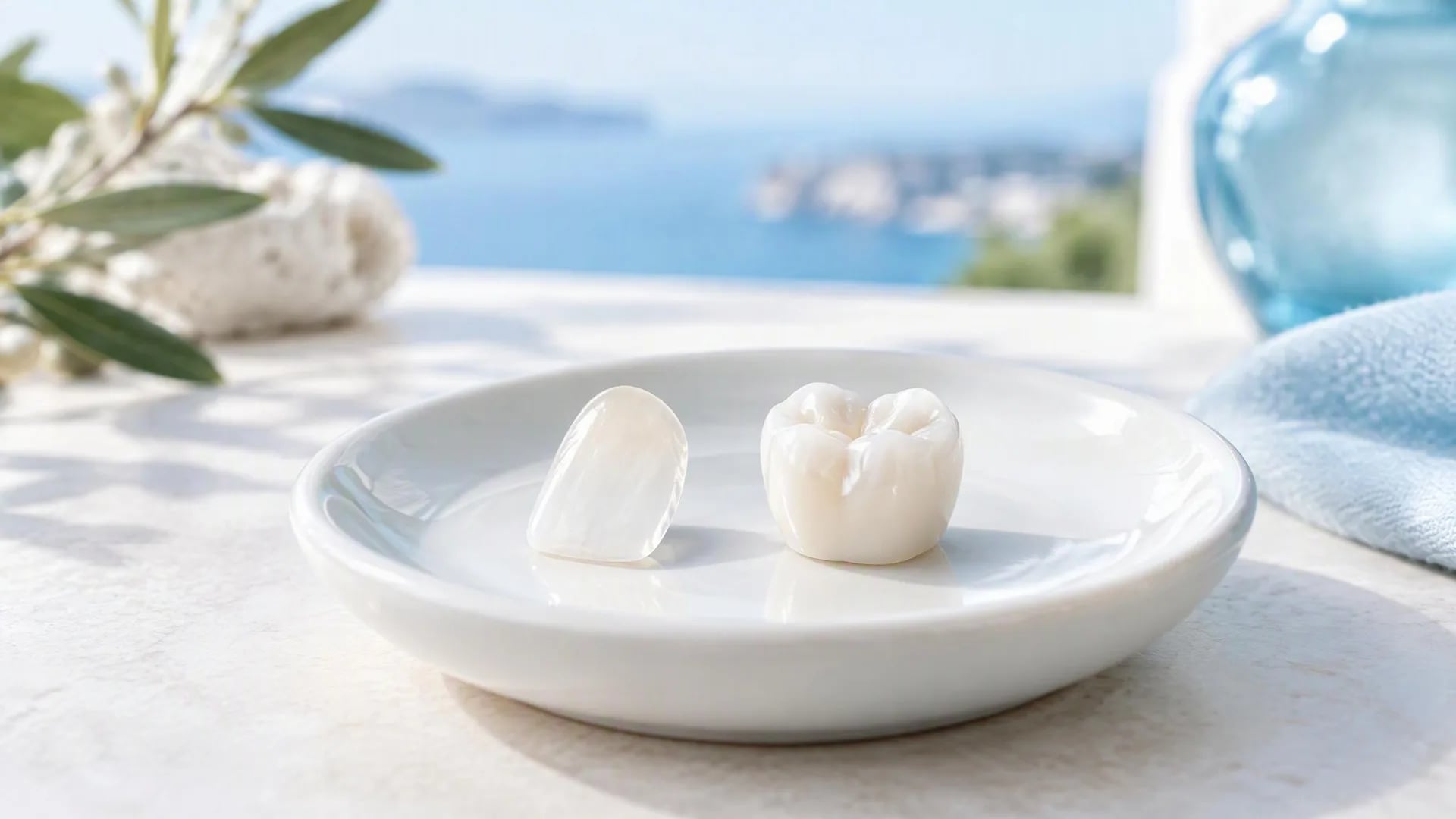
A veneer is a thin covering fixed to the front surface of a tooth to improve its colour, shape or position, as the Oral Health Foundation explains. They are used to cover teeth that whitening hasn't lightened, to repair chips or worn edges, to close small gaps, and to even out teeth that are an uneven shape or size.
Two materials are used. Porcelain veneers are custom shells made in a dental laboratory; the American Dental Association's MouthHealthy service describes them as strong, long-lasting and natural-looking, though they tend to cost more than the alternative. Composite veneers use a tooth-coloured filling material built up directly on the tooth; they usually need less enamel removed and fewer visits, and they're easier to repair, but they stain and wear faster than porcelain. Clinics in Antalya commonly offer e.max (lithium disilicate) porcelain for its strength and translucency, alongside traditional feldspathic porcelain.
Are You a Good Candidate?
Veneers work best on teeth that are structurally healthy. Both the ADA and the Oral Health Foundation note that any decay or gum disease needs treating first, and your dentist should assess your bite and oral hygiene before planning treatment. People who clench or grind their teeth heavily, or who have a deep overbite, may be poor candidates, since the extra load can chip or loosen a veneer. A thorough assessment — including x-rays and photographs — before any treatment plan or quote is issued is standard good practice, not an optional extra.
The Veneer Process in Antalya: What to Expect Step by Step
Most Antalya clinics plan porcelain veneers around a single trip, by compressing the laboratory stage with faster in-house milling or by shipping cases to a lab mid-stay. A typical sequence looks like this:
- Consultation and planning. X-rays, photographs and a discussion of what you want to change. This is also when a dentist should flag if veneers aren't the right fit for your teeth.
- Preparation. A small, measured amount of enamel is removed from the front of each tooth involved, and a digital scan or physical impression is taken and sent to the laboratory.
- Temporary veneers. While the permanent set is made, temporary veneers protect the prepared teeth and give you a preview of the shape and shade.
- Fitting. The dentist checks the fit, colour and bite, makes any adjustments, then bonds the final veneers with a strong dental adhesive.
Our own veneers treatment page sets out how we structure this around travel days, and a written treatment plan — based on your x-rays and photos — is issued before you commit to dates or treatment, in line with the standard the Oral Health Foundation and ADA both describe.
Do Veneers Damage Your Natural Teeth?
Used honestly: veneers are not reversible, because the dentist removes a layer of enamel to fit them, and enamel does not regenerate. That is a genuine, permanent change to the tooth, and it's worth sitting with before you decide — the ADA is explicit that this is why licensed, qualified dentists should be the only people doing this work. Done well, on suitable teeth, the procedure itself does not make a tooth weaker in daily use than it was before. What does cause problems afterwards is neglect: both the ADA and the Oral Health Foundation warn that you can still get decay under or around the edge of a veneer if you don't keep up ordinary brushing and interdental cleaning, and a veneer can chip, crack or come loose over the years regardless of material. Good oral hygiene and regular check-ups are what keep both the veneer and the tooth underneath it healthy for longer.
Veneers, Crowns or Zirconium Crowns — Which Fits Your Case?
Veneers only cover the front surface of a tooth, which is why they remove far less structure than a crown, which wraps the whole tooth. That makes veneers a better fit for teeth that are cosmetically compromised but structurally sound, and crowns or zirconium crowns a better fit for teeth that are heavily filled, cracked, root-treated or significantly broken down. If you're not sure which category your teeth fall into, our detailed comparisons on veneers vs crowns and E.max vs zirconia crowns go through the trade-offs in more depth, and a dentist reviewing your x-rays can tell you which option actually applies to you — this is not something a photo alone can answer.
| Factor | Porcelain veneers | Composite veneers |
|---|---|---|
| Enamel removed | Small, measured amount | Minimal, sometimes none |
| Typical visits | Two (prep + fit) | Often one |
| Stain resistance | High | Lower over time |
| Repairability | Usually needs replacement | Can often be repaired chairside |
Choosing a Clinic: What to Verify Before You Book
This is the section most veneer marketing skips, so it's worth spelling out. UK patients can check whether a dentist is registered with the General Dental Council if any part of their assessment happens in the UK, though the GDC itself is candid that dental regulation varies by country and it cannot guarantee an equivalent body exists elsewhere — which is exactly why asking direct questions matters more when treatment happens abroad. The GDC's suggested questions are worth asking any clinic, anywhere: who will treat you and what their qualifications are, whether the team speaks your language fluently, what aftercare is included, and what happens — and who pays — if something needs correcting. Patients from Ireland, the US, Canada, Australia or New Zealand can put the same questions to their own dentist and ask their national regulator (for example the Irish Dental Council, a state dental board in the US, or the Dental Board of Australia) whether it offers similar guidance.
It's also worth reading the UK Foreign, Commonwealth & Development Office's current travel advice for Turkey in full before booking any medical or dental procedure there. It is blunt: standards can vary widely between providers, some British nationals have needed further treatment after complications, and the FCDO does not endorse any specific clinic — including Health Talia or any other provider. The advice also flags that UK and EU health insurance cards are not valid in Turkey, so separate travel insurance that covers your treatment is worth arranging regardless of where you book. None of this means treatment in Turkey is unsafe by default; it means due diligence — checking a clinic's accreditation, asking to see dentists' qualifications, and getting your treatment plan in writing — is the responsible step, wherever you travel from.
Aftercare and How Long Veneers Last
Porcelain veneers can last many years with consistent care, though no dental material is permanent, and both source organisations note they will eventually need re-bonding, repair or replacement. Brush twice daily with fluoride toothpaste, clean between your teeth daily, and avoid using your front teeth to bite fingernails, pens or anything harder than food. If you grind your teeth, a night guard protects the veneers while you sleep. Limiting coffee, tea, red wine and other strongly staining drinks keeps porcelain looking its best, since while porcelain itself resists staining well, the bonding margin can still pick up discolouration over time.
FAQ
How many days do I need in Antalya for veneers?
Most straightforward veneer cases are planned around one trip of roughly five to seven days, allowing for the consultation, preparation visit, laboratory turnaround and a final fitting appointment, plus a buffer day in case any adjustment is needed. Complex cases involving many teeth, or treatment combined with other dental work, may need a longer stay or a second trip — your written treatment plan will specify this before you travel.
Do veneers damage your natural teeth?
The procedure permanently removes a small layer of enamel, which does not regrow, so it is not reversible — but on suitable, healthy teeth, done by a qualified dentist, it does not weaken the tooth in everyday use. Problems mostly arise from poor oral hygiene afterwards, which can lead to decay at the veneer's edge.
What's the difference between veneers and crowns?
Veneers cover only the visible front surface of a tooth and remove comparatively little structure; crowns cover the entire tooth and are used when more of the natural tooth is already damaged, filled or weakened. See our full veneers vs crowns comparison for how dentists decide between them.
Can veneers be removed or reversed later?
Not in the sense of returning the tooth to its original, untouched state, because the enamel removed during preparation does not come back. A veneer itself can be removed and replaced with another veneer or a crown if your plans change, but the tooth underneath will always need some form of covering afterwards.
Will I need temporary veneers during treatment?
Usually, yes, between the preparation visit and the fitting visit, while the permanent veneers are made in a laboratory. Temporary veneers protect the prepared teeth and give you a rough preview of the final shape and shade.
If you're considering porcelain veneers and want an honest view of whether your teeth are a good fit, send a few photos and your questions over WhatsApp on +90 536 500 0744, or request a free consultation and written treatment plan after a free x-ray review. There's no obligation, and no pressure to decide anything on the spot.
Sources
Planning veneers or a Hollywood Smile?
Share a few smile photos and a recent x-ray. A dentist reviews them and explains realistic options for your smile, free.
Reply within 24 hours on WhatsApp
Related articles

8 min readIllustrative
Dental Treatment in Turkey from Canada: Flights, Visa and Trip Planning
A practical guide for Canadian patients: flights to Antalya, visa rules, trip length, insurance and planning aftercare with your home dentist.
8 min readIllustrative
Zirconia Crowns vs PFM Crowns: What the Evidence Shows
Zirconia or porcelain-fused-to-metal? Compare strength, appearance, allergy risk and lifespan using NHS, ADA and peer-reviewed evidence.