
Dentures in Antalya: Types, Candidacy and What to Expect
A practical, evidence-based guide to full, partial and implant-retained dentures in Antalya: candidacy, visits, aftercare and honest limits.
What you need to know
A practical, evidence-based guide to full, partial and implant-retained dentures in Antalya: candidacy, visits, aftercare and honest limits.
A practical, evidence-based guide to full, partial and implant-retained dentures in Antalya: candidacy, visits, aftercare and honest limits.
Dentures replace missing teeth with a removable or implant-retained appliance, and the right type depends on how many teeth are missing, the health of your gums and jawbone, and how you want to manage upkeep. Most people need an in-person assessment and at least two to three visits — a trial fitting is rarely optional — so understanding the process before you fly to Antalya helps you plan a realistic trip.
What are dentures, and which type might suit you?
A denture is a removable (or, in some designs, fixed) appliance that replaces missing natural teeth and the surrounding gum tissue. According to NHS guidance on dentures, the main types are full dentures, which replace all the teeth in an upper or lower arch, and partial dentures, which fill in gaps while remaining natural teeth are still in place.
- Full (complete) dentures replace every tooth in an arch and rest on the gum ridge, held by suction and saliva rather than by implants.
- Partial dentures clip onto remaining natural teeth with small metal or plastic clasps and fill one or more gaps.
- Immediate dentures are fitted on the same day teeth are extracted, so you are not without teeth during healing, though the ADA's MouthHealthy guide to dentures notes they commonly need relining or remaking once the jaw has finished healing and changing shape.
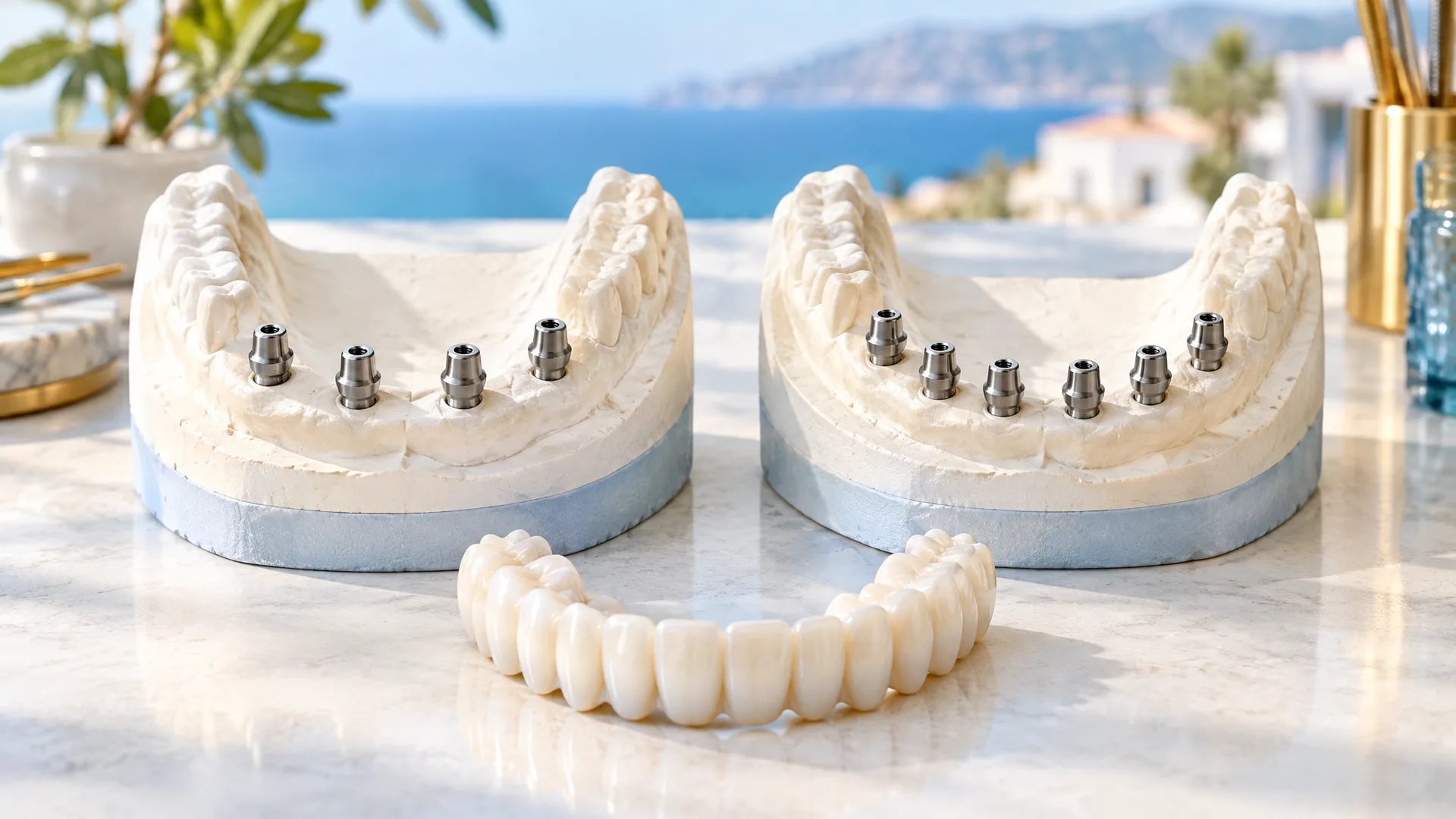
- Implant-retained (overdenture) dentures clip onto two or more implants for a more secure fit. This is a different clinical pathway with its own healing timeline — see our separate guide to implant-retained dentures in Antalya if that route interests you.
Which option is realistic for you depends on an examination of your gums, the bone remaining under the ridge, your bite, and how many natural teeth (if any) remain. No remote photo review can finalise this; it can only narrow the likely options ahead of an in-person check.
Conventional dentures vs implant-retained dentures: how the decision is usually made
Patients often ask whether to go straight for implant-retained dentures instead of a conventional removable denture. Both are legitimate options, and the right one depends on bone volume, budget expectations, general health and how much a looser-fitting removable denture would bother you day to day.
| Factor | Conventional denture | Implant-retained denture |
|---|---|---|
| Stability | Held by suction/saliva; can move when eating or speaking | Clips onto implants; generally more secure |
| Bone requirement | Minimal; suited to resorbed ridges | Needs sufficient bone, or grafting first |
| Healing time before fitting | Short; limited by extraction healing only | Implants typically need a healing period before the final denture is attached |
| Long-term bone change | Ridge continues to resorb under the denture over years | Implants help preserve bone at the implant sites |
| Maintenance | Removed, brushed and soaked daily; occasional relining | Daily cleaning plus professional checks of implant components |
Neither option is guaranteed to last indefinitely, and both need a clinician to examine your mouth before a plan is confirmed. Health Talia does not publish fixed prices for either route; a written plan follows a free photo or x-ray review, and the exact design is only confirmed after an in-person examination in Antalya.
What actually happens during a denture appointment in Antalya?
A conventional complete or partial denture is rarely a one-visit treatment, even though it does not involve surgery. The usual stages are:
- Assessment and records — examination, x-rays if needed, and a discussion of what is realistic given your remaining teeth and gum health.
- Primary impressions and bite registration — moulds of your gums and a record of how your jaws meet.
- Trial denture (wax try-in) — a wax or acrylic trial is fitted so you and the dentist can check appearance, bite and fit before the final denture is processed.
- Delivery and adjustment — the finished denture is fitted, and at least one follow-up adjustment is common as your gums adapt to it.
Each stage after the first usually needs laboratory turnaround time between appointments, which is why denture treatment does not compress into a single long day in the chair. If teeth need extracting first, your dentist and Health Talia's coordinators will factor in healing time before final impressions are taken.
How many visits and how long should you plan to stay?
Expect at least two to three in-clinic visits spread across your trip, not one. Our separate guide on how long to stay in Turkey for dental treatment covers the general pattern of spacing appointments around lab work; for dentures specifically, ask your dentist in writing how many trial stages your case needs and whether any can be combined, since this varies with the complexity of your bite and whether teeth are being extracted on the same trip.
If you are travelling from the UK, Ireland, the US, Canada, Australia, New Zealand or elsewhere, build in a buffer day either side of your flights in case an adjustment visit needs rescheduling. A rushed schedule is the most common reason denture patients feel pressured into accepting a fit that is not quite right.
Caring for your dentures and adjusting in the first few weeks
New dentures usually feel strange at first — looser speech, extra saliva, and mild sore spots while your mouth adapts are common and expected, not necessarily a sign of a poor fit. The Oral Health Foundation's denture care guidelines recommend brushing dentures daily with a soft denture brush and a purpose-made denture cleanser, never ordinary toothpaste, which is abrasive enough to scratch denture surfaces over time.
- Remove and rinse dentures after meals to clear food debris.
- Brush remaining natural teeth and gums with fluoride toothpaste, separately from the denture itself.
- Soak dentures in a suitable cleanser (never boiling water, which can warp acrylic) and keep them moist when out of the mouth.
- Remove dentures overnight where clinically appropriate — your dentist can advise on your individual situation, as Mayo Clinic's guidance on denture care explains.
- If you use denture adhesive, remove it fully each day; adhesive is not a substitute for a denture that fits properly.
Book a professional review at least once a year, even once you are home, so fit and oral health can be checked as your gums and jawbone continue to change shape over time.
Risks, honest limits and when to get help
Dentures are not risk-free and do not last forever. Ill-fitting dentures can cause sore spots, ulcers or, if hygiene lapses, oral thrush or gum irritation. NHS guidance advises seeing a dentist if your dentures become loose, worn, cracked, or if you develop persistent soreness — do not try to repair a denture yourself or use superglue, which is not safe for use in the mouth.
Because the gum ridge continues to change shape for months or years after teeth are lost, a denture that fits well today may loosen later and need relining, adjusting or eventually remaking — this is normal maintenance, not a sign that the original work failed. No clinic can honestly promise a denture will never need adjustment.
Before you travel, ask your Antalya dentist in writing: what the plan includes if a trial stage needs repeating, who to contact if a sore spot develops after you fly home, and whether remote adjustment advice is available if a minor issue arises once you are back in your own country.
FAQ
Can I get dentures in one trip to Antalya?
Possibly, if your case is simple and no extractions are needed first, but most conventional dentures involve a trial fitting stage with laboratory turnaround between visits. Ask for a written, case-specific schedule rather than assuming a single-day fit.
Are implant-retained dentures better than conventional ones?
Not automatically — they are more stable for many patients but require adequate jawbone, a healing period after implant placement, and ongoing professional maintenance. Your suitability for either option can only be confirmed after an in-person examination.
Will my denture let me eat normally straight away?
Expect an adjustment period. Many people start with softer foods and build up gradually as they get used to biting and chewing with a denture in place; some sore spots in the first weeks are common and usually resolve with minor adjustments.
How long do dentures last before they need replacing?
There is no fixed lifespan. Dentures can need relining, adjusting or remaking as your gums and jawbone change shape, so no provider can honestly guarantee a set number of years without an in-person review.
What should I check before booking denture treatment abroad?
Ask for a written plan covering the number of expected visits, what happens if a trial fitting needs repeating, how adjustments are handled after you return home, and who the treating, registered clinician will be.
Health Talia does not display fixed prices; every denture plan follows a free photo or x-ray review and is confirmed after an in-person assessment in Antalya. If you are weighing up dentures for your own situation, message our team on WhatsApp at +90 536 500 0744 or request a free consultation and treatment plan to discuss realistic timing around your trip.
Sources
Planning dental treatment in Turkey?
Send your x-ray or photos and receive a written treatment plan from a dentist at a licensed clinic in Antalya, free and with no obligation.
Reply within 24 hours on WhatsApp
Related articles

9 min readIllustrative
Medical Conditions and Dental Treatment Abroad: What to Tell Your Dentist Before You Fly to Turkey
Diabetes, blood thinners, osteoporosis drugs or smoking? Here's what to disclose before dental treatment in Antalya, and why it matters.
8 min readIllustrative
Aftercare, Emergency Support and Follow-Up: What to Confirm Before Dental Treatment in Antalya
What UK and international patients should confirm about aftercare, emergency contact and follow-up before booking dental treatment in Antalya.