
Dental Implant vs Bridge: Which Option Fits the Gap?
A diagnosis-first comparison of implants and bridges for one or more missing teeth, including trade-offs and questions for your consultation.
What you need to know
An implant replaces a missing root and supports a separate crown without relying on adjacent teeth, but it needs surgery, suitable bone and healing. A conventional bridge fixes a replacement tooth to neighbouring teeth and may avoid implant surgery, but those supporting teeth usually need preparation. The better fit depends on the gap, adjacent teeth, gums, bone, bite, health, timescale and maintenance—not the label alone.
Key takeaways
- If adjacent teeth already need crowns, a bridge may use restorations that are clinically indicated; preparing healthy teeth changes the balance.
- An implant is a staged surgical-restorative treatment and may need grafting; ask what happens during the gap and healing period.
- Both options require daily cleaning and professional review, but the technique and possible complications differ.
- Compare the complete plan, alternatives and future repair pathway rather than a headline package.
A missing tooth can sometimes be replaced with an implant-supported crown or a bridge supported by neighbouring teeth. Neither is automatically better. The useful comparison is whether adjacent teeth need treatment, whether bone and gum conditions support an implant, how many stages are acceptable and how each option will be cleaned and maintained.
How do an implant and a bridge replace a missing tooth?
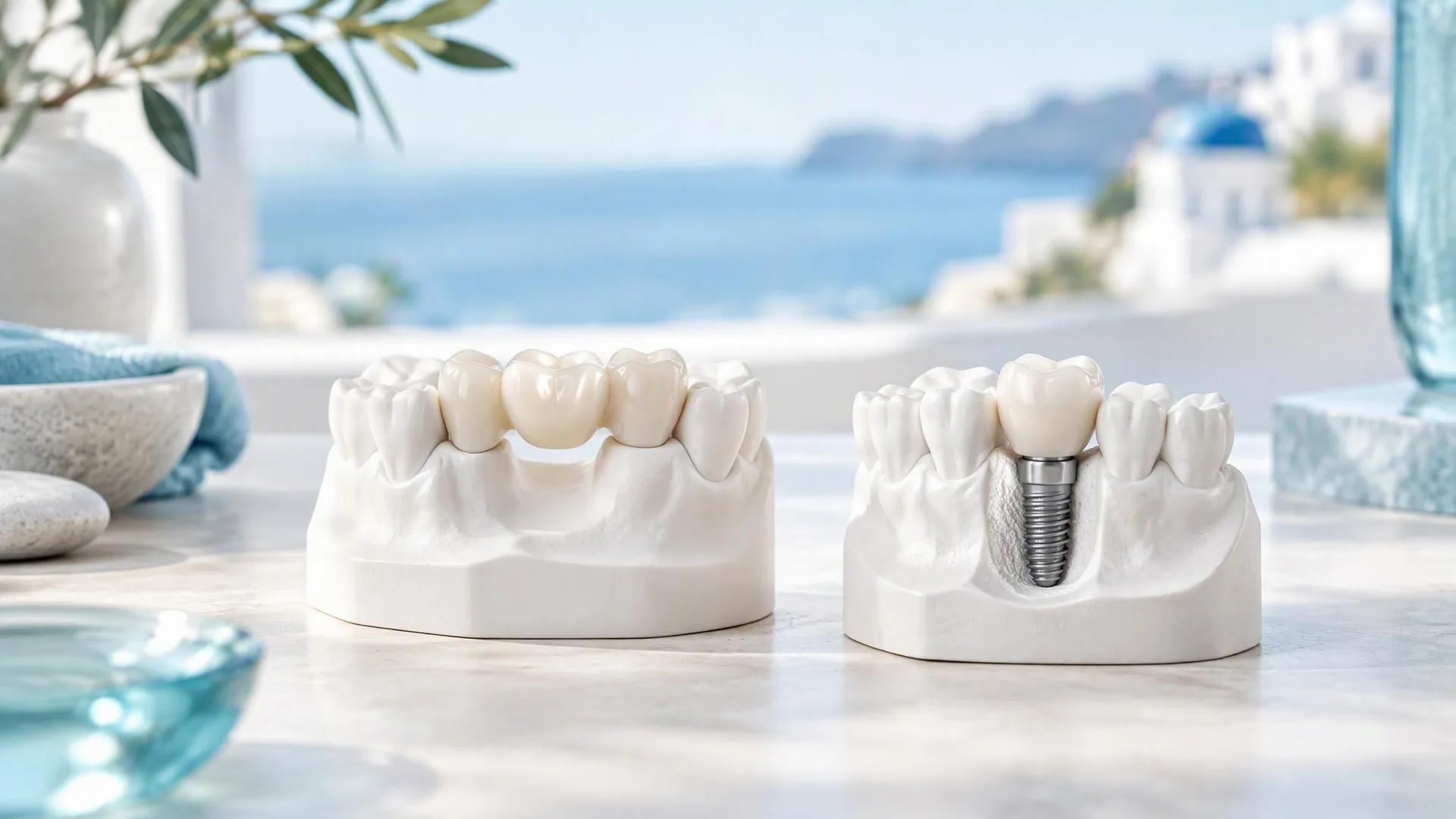
An implant supports the replacement from the jaw; a bridge spans the gap using one or more neighbouring teeth as supports.
An implant restoration has separate surgical and restorative parts: the implant fixture, an abutment and the visible crown. A conventional bridge usually includes a false tooth joined to crowns on adjacent teeth. Resin-bonded bridges use a different, more conservative design in selected situations.
The number of missing teeth, span length, available tooth structure, root condition and bite affect which bridge designs are realistic. Implant planning additionally considers bone volume, anatomical structures, gum stability and surgical risk.
Which clinical factors change the decision?
The condition of the supporting teeth, bone and gums often matters more than age or a preference for one material.
A heavily restored tooth beside the gap may already need protective coverage, while an intact tooth may make extensive bridge preparation less attractive. For an implant, active gum disease, smoking, poor plaque control, uncontrolled medical risk or insufficient bone can change timing, risk or suitability.
Ask the clinician to show the diagnosis tooth by tooth and explain why leaving the gap, using a removable denture, choosing a resin-bonded bridge or delaying treatment was accepted or rejected.
| Decision point | Implant pathway | Bridge pathway |
|---|---|---|
| Adjacent teeth | Usually not used as supports | May need preparation or bonding |
| Bone and surgery | Adequate bone and surgical assessment needed | No implant placement surgery |
| Timeline | Often staged with a healing phase | Usually laboratory and fitting stages |
| Cleaning | Around the crown and implant tissues | Under the replacement tooth and around supports |
| Future problems | May involve implant tissues, components or crown | May involve supporting teeth, cement, connector or porcelain |
What should an international patient confirm before choosing?
Confirm the provisional plan, number of visits, temporary tooth, maintenance and who manages complications after you return home.
Health Talia can review a remote photograph or x-ray to start the conversation, but this cannot establish bone, root, decay, gum and bite findings. Ask which records support the preliminary plan and which decisions remain conditional on examination and imaging in Antalya.
The written plan should identify every supporting tooth, implant and restoration, explain alternatives, and state what changes if a tooth or bone finding differs after examination.
- Which adjacent teeth need treatment even if I do not choose a bridge?
- Is three-dimensional imaging required for the implant option?
- What temporary replacement will I have between stages?
- How will I clean the restoration and who provides maintenance at home?
- What records and component details will I receive?
Frequently asked questions
Short answers to the questions international patients ask most often.
Is an implant always better than a bridge?
No. An implant avoids using neighbouring teeth as supports but introduces surgery, healing and implant-specific risks. A bridge may be reasonable when supporting teeth already need restoration or implant treatment is unsuitable.
Does a bridge always damage healthy teeth?
Conventional bridges normally require preparation of supporting teeth, but the amount and clinical significance vary. Resin-bonded designs can be more conservative in selected cases.
Can I decide from a panoramic x-ray alone?
Not reliably. The decision also requires a clinical examination of teeth, gums, bite and restorability; implant planning may require three-dimensional imaging.
References and further reading
Authoritative guidance and research checked for this article. Last source review: September 3, 2026.
Thinking about dental implants?
Send your x-ray and a dentist at a licensed clinic in Antalya reviews it and prepares a written implant plan, free and with no obligation.
Reply within 24 hours on WhatsApp
Related articles

Dental Implants10 min readIllustrative
Dental Implant Cost in Turkey: What Actually Changes Your Quote
The clinical and travel factors that change an implant quote, what a transparent written quote should include, and why a figure without an x-ray means little.
Dental Implants9 min readIllustrative
Bone Graft or Sinus Lift Before Dental Implants?
A patient guide to grafting decisions, staged implant timing, alternatives and the questions that should be answered before travel.