
All-on-4 in Turkey: What Actually Determines Your Treatment Plan and Quote
All-on-4 quotes in Turkey vary by implant count, material, loading protocol and aftercare, not a fixed price list. Here is what shapes your plan.
What you need to know
All-on-4 quotes in Turkey vary by implant count, material, loading protocol and aftercare, not a fixed price list. Here is what shapes your plan.
All-on-4 quotes in Turkey vary by implant count, material, loading protocol and aftercare, not a fixed price list. Here is what shapes your plan.
An All-on-4 quote for treatment in Turkey is built around your treatment plan, not a price list. The number on a written quote changes with how many implants are used, what the bridge is made from, whether you need a bone graft or extractions first, and what loading protocol your dentist recommends. Health Talia does not publish a fixed figure for All-on-4 treatment in Antalya; a free x-ray review is used to build an individual plan before a written quote is issued.
What All-on-4 actually involves
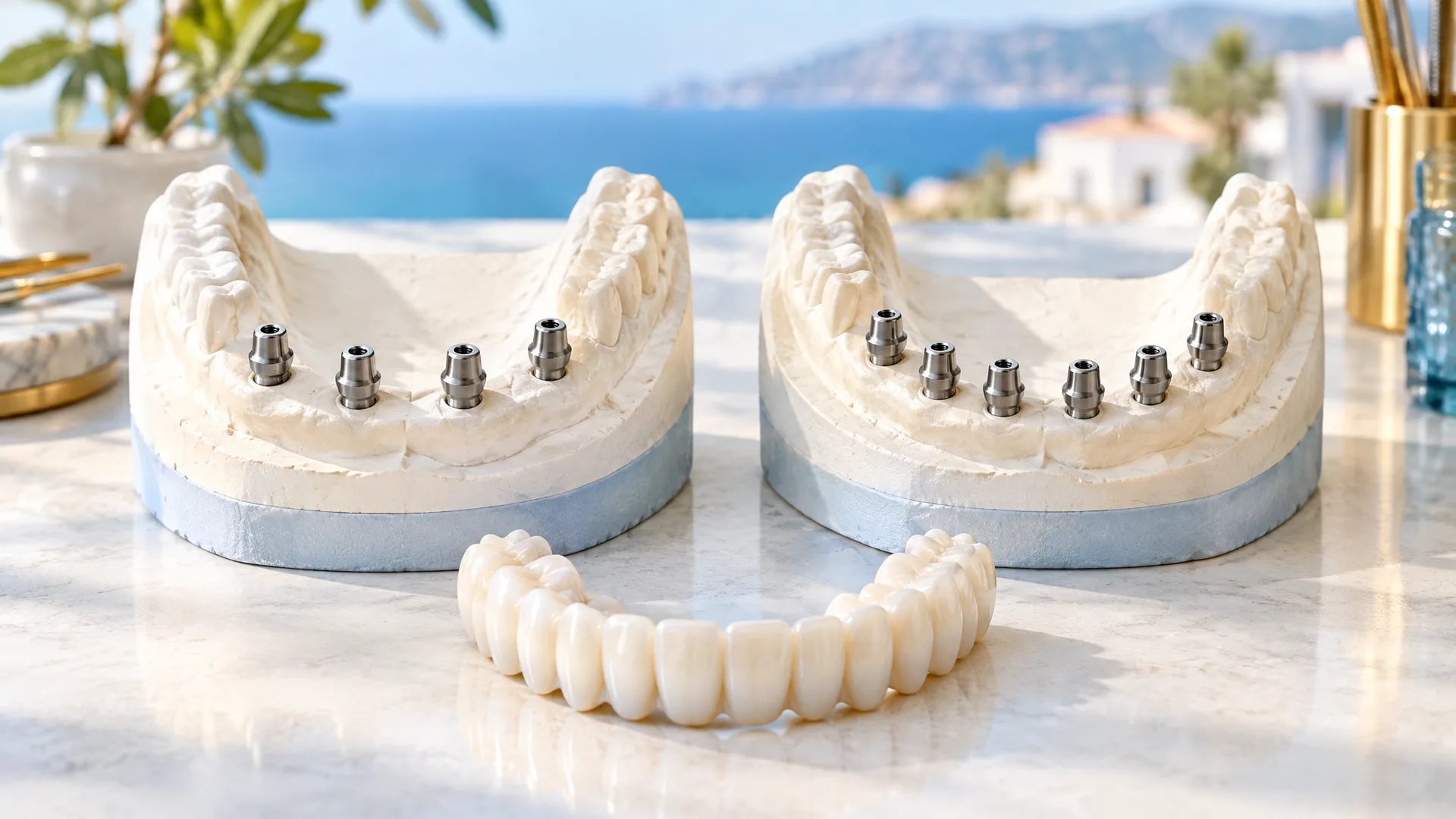
All-on-4 is a fixed, implant-supported bridge that replaces a full arch of teeth using four implants, two placed upright at the front of the jaw and two angled further back to avoid the sinus cavity or a nerve canal. The angled rear implants are the detail that makes the "four implant" concept viable for many patients who have lost bone at the back of the jaw, because they use the bone that is already there instead of requiring it to be rebuilt first.
According to UK NHS guidance on having a dental implant, treatment is staged: a pre-operative assessment with X-rays and impressions, placement of the implant under local anaesthetic, a healing period of at least three months before the implant can safely support replacement teeth, and a separate restorative stage to make and fit the final bridge. If a bone graft is needed first, the NHS notes this can add four to six months to the overall timeline. These stages apply to All-on-4 as they do to single implants; the difference is that four implants are planned together to support one connected prosthesis rather than individual crowns.
Why your quote will look different from someone else's
Two patients can both be told "All-on-4" and receive very different written quotes, because the term describes a concept, not a fixed package. The factors below are the ones that most often change the plan, and each one is worth asking your dentist about directly before you travel.
The table below sets out what changes an All-on-4 treatment plan and quote.
| Factor | Why it changes the plan | Question to ask |
|---|---|---|
| Bone condition at each implant site | Determines whether a graft, sinus lift or extraction is needed before implants can be placed | Does my scan show enough bone at all four planned positions? |
| Bridge material | Acrylic-on-titanium, milled zirconia and porcelain-fused frameworks differ in cost, strength and how they wear over time | What is the final bridge made from, and is a provisional bridge included separately? |
| Loading protocol | Same-day "teeth in a day" provisional bridges need different planning from a delayed-loading approach | What happens on the day of surgery, and what is the fallback if immediate loading is not suitable? |
| Extractions before treatment | Removing remaining teeth in the arch adds a surgical step and may change healing time | Are any extractions included in this quote, and at what stage? |
| Number of visits and aftercare included | Hotel nights, transfers, interpreter support and follow-up reviews vary between providers | Exactly how many clinic visits and nights in Turkey does this plan assume? |
Because of this variation, a quote is only genuinely comparable to another quote if both cover the same bridge material, the same number of implants, the same stage of extractions or grafting, and the same aftercare period. A lower number on its own does not tell you whether the scope is the same.
Immediate loading, or "teeth in a day": what the evidence actually shows
Immediate loading means attaching a temporary bridge to the implants on the day of surgery, rather than waiting through a healing period before any teeth are fitted. It is one of the reasons All-on-4 is marketed as a fast full-arch solution, and it can be appropriate when implant stability, bone quality and bite forces are controlled for.
A peer-reviewed study of immediate loading on a template-guided, four-implant full-arch prosthesis illustrates how precisely this protocol has to be planned: implant position, angulation and the fit of the guide are all controlled before the temporary bridge is attached. This is not a shortcut version of treatment; it is a different, more tightly sequenced protocol that still depends on your bone and bite meeting specific criteria on the day. If you are not a suitable candidate for immediate loading, a safe alternative is to use a removable temporary during healing and fit the fixed bridge once the implants are ready, and a dentist following good practice should tell you which pathway applies to you rather than assuming immediate loading by default.
Risks and candidacy worth discussing before you travel
The US FDA's patient guidance on dental implants lists general health, smoking status and the likely healing time as factors that affect whether implants are a good option and how long treatment will take. Its listed risks for implant systems include infection, injury to nearby teeth or tissue during placement, implant looseness or failure, and nerve-related numbness; it also notes that failure may be more likely where systemic infection, uncontrolled diabetes or smoking slow healing. None of these risks are specific to treatment abroad, but they are exactly the points a dentist should cover with you before confirming an All-on-4 plan, wherever you are treated.
A full-arch case also carries a planning risk that a single implant does not: because several implants support one connected bridge, it is worth asking in advance what happens if one implant does not integrate as expected. A dentist working to a defensible plan should be able to describe a contingency, not just the ideal outcome.
Aftercare that should be part of the plan, not an afterthought
The American College of Prosthodontists' position statement on maintaining full-arch implant restorations recommends in-office maintenance visits roughly every two to six months, with the interval set by individual risk factors such as smoking history, previous gum disease and how easily the patient can clean around the bridge at home. It also states that daily brushing, flossing or interdental cleaning, and the use of a water irrigator are part of keeping a full-arch bridge healthy, and that removing a well-functioning screw-retained bridge for no clinical reason is not good practice.
For anyone treated abroad, this points to a practical question for your written quote: does it include guidance on home care, a plan for review visits after you return home, and clear instructions for a dentist nearer home if a problem comes up between visits to Turkey? A plan that only covers the days you are physically in Antalya is incomplete.
How to get a plan-specific answer instead of a price estimate
Because the figures above depend on your own bone, bite and health, the only reliable way to find out what an All-on-4 quote would look like for you is to have your case reviewed individually. Health Talia's process starts with a free consultation and x-ray review, after which a written treatment plan sets out the implant count, bridge material, loading approach and included aftercare for your case specifically, before any commitment is made. Comparisons between providers are only meaningful once you are comparing the same scope of treatment.
FAQ
Is All-on-4 the same as All-on-6?
No. All-on-4 uses four implants per arch; All-on-6 uses six. More implants are not automatically better, and the right choice depends on bone, bite and the planned bridge design. See our All-on-4 vs All-on-6 comparison for the clinical factors behind that decision.
Can I get teeth in a day with All-on-4?
Sometimes. Immediate loading of a temporary bridge is possible for some patients when implant stability and bite forces allow it, but it is not suitable for everyone and should never be assumed without an individual assessment.
Do I need a bone graft for All-on-4?
Not always. The angled rear implants used in All-on-4 are partly designed to make use of existing bone, but some patients still need grafting, which can extend the overall timeline by several months according to NHS guidance.
How many trips to Turkey does All-on-4 usually need?
This depends on your loading protocol and healing progress. A plan involving delayed loading typically needs a first trip for assessment, surgery and a provisional bridge, and a second trip once healing is confirmed for the final bridge; your written plan should state this clearly for your case.
How do I compare two All-on-4 quotes fairly?
Check that both quotes cover the same number of implants, the same final bridge material, whether extractions or grafting are included, and the same aftercare and follow-up period. A quote that is silent on these points is not comparable, whatever the headline figure.
If you would like your own case reviewed before travelling, Health Talia offers a free consultation based on your x-rays and dental history. You can start on WhatsApp at +90 536 500 0744 or request a written treatment plan online.
Sources:
- NHS guidance: Having a dental implant (Guy's and St Thomas' NHS Foundation Trust)
- FDA: Dental Implants – What You Should Know
- American College of Prosthodontists: Position Statement on Maintenance of Full-Arch Implant Restorations
- Peer-reviewed study: Immediate loading of a fixed full-arch prosthesis on four template-guided implants (PubMed)
Considering All-on-4 or All-on-6?
A full-arch plan depends on your bone and gums. Share a recent x-ray and get a written plan that explains which option may suit you, free.
Reply within 24 hours on WhatsApp
Related articles

8 min readIllustrative
Are Veneers in Turkey Safe? A UK Patient's Verification Checklist
A UK patient's checklist for verifying veneer safety in Turkey: dentist registration, lab material, written plans and aftercare matter most.

9 min readIllustrative
Is Antalya Safe for Dental Treatment? What Official Advice Actually Says
Is Antalya safe for dental treatment? What UK, Irish, Australian and Canadian official advice says, and how to judge safety by clinic, not city.